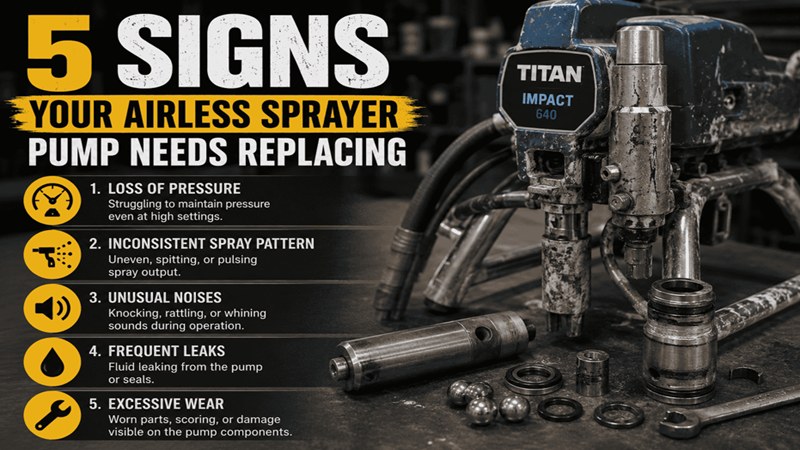
Airless sprayer pumps don’t quit without warning. In nearly every case we’ve seen over more than two decades in this industry, a pump that fails on the job was signaling a problem for weeks before the machine stopped running. The contractor either didn’t recognize the symptoms or kept pushing through them, hoping the problem would resolve itself.
It won’t. And the cost of ignoring a failing pump compounds. A worn inlet valve that’s caught early costs you a valve replacement and an hour of bench time. That same worn valve left in service for six more weeks can score the piston rod, accelerate packing failure, and turn a $40 part into a complete fluid section rebuild.
This guide covers the five clearest signs that a pump is telling you it needs service — and what each symptom is actually communicating about the condition of the components inside.
How Pump Wear Actually Works
Before the symptoms make sense, a quick picture of what’s happening inside.
An airless sprayer pump works through a repeating two-stroke cycle. On the upstroke, the piston creates negative pressure that pulls material in through the inlet valve. On the downstroke, it seals the inlet valve and forces material out through the outlet valve at high pressure toward the gun.
Every wear component in that cycle — the packing around the piston rod, the inlet valve ball and seat, the outlet valve ball and seat, the piston rod surface itself — degrades gradually under the pressure, friction, and material contact of normal use. Wear doesn’t happen all at once. It accumulates. And as it accumulates, it produces specific, recognizable symptoms before it produces failure.
Sign 1: Pressure That Pulses While You’re Spraying
A properly functioning airless sprayer holds consistent pressure at the gun. If your spray pattern is pulsing — alternating thick and thin coverage in a steady rhythm — the pump is not maintaining even pressure between strokes.
This rhythmic pulsing is almost always a valve problem. Either the inlet valve is not closing completely on the downstroke, allowing material to escape backward instead of forward, or the outlet valve is not sealing on the upstroke, allowing backflow from the hose to reduce pressure between pumping cycles. Either way, the pump is losing a fraction of the pressure it generates on every stroke.
Mild pulsing can also come from worn packing that’s allowing some material to bypass the piston rod seal, but packing-related pressure loss tends to show up as general pressure reduction rather than rhythmic pulsing.
Pulsing is an early warning sign. The machine is still functional, but it’s telling you that valve service is overdue. Catch it here with a valve replacement and you’re done in an hour. Let it run until the pattern becomes severe and you’ll likely find that the compromised valve has been working the packing harder than normal, meaning a valve replacement now becomes a valve-plus-packing replacement.
Sign 2: Material Appearing in or Around the Wet Cup
The wet cup is the small reservoir surrounding the piston rod at the top of the fluid section. It exists to hold pump armor or throat seal oil, which lubricates the packing on every stroke and protects the rod surface. Material appearing in the wet cup — coating, paint, stain — coming up from below means the packing is no longer sealing the boundary between the fluid section and the exterior of the machine.
This is not ambiguous. Material in the wet cup is packing failure. The only question is how far along the failure is.
If you catch it early, you see a slight discoloration of the pump armor in the wet cup. A more advanced failure shows actual coating material pooling in the cup, and a severe failure means material dripping from the wet cup area during operation.
Some contractors add solvent to the wet cup and keep running. This temporarily reduces friction and may slow the visible symptom, but it does nothing to address the failing packing. Meanwhile, the compromised packing is allowing abrasive material to contact the piston rod surface on every stroke, which is how a packing problem becomes a rod problem. Repacking kits for Titan, SprayTech, and Wagner sprayers are the correct response — not more pump armor. The rebuild stops the damage and resets the service interval.
Sign 3: Priming Takes Significantly Longer Than It Used To
When a pump is in good condition, it primes within seconds — a few cycles to fill the suction path and purge air, then consistent pressure. As wear accumulates, priming takes progressively longer. You find yourself holding the trigger for thirty seconds, then a minute, before the machine builds pressure and delivers consistent flow to the gun.
Extended priming time indicates reduced volumetric efficiency. The pump is cycling, but each cycle is delivering less net material forward than it should — because worn packing is allowing some bypass around the piston rod, because worn valves are allowing some backflow, or both. The pump has to run more cycles to accomplish what it used to accomplish in fewer.
Extended priming is also one of the clearest signs of a worn suction filter or a developing crack in the suction hose — both of which introduce air into the fluid path and force the pump to work harder to build suction. Before assuming the pump itself is the problem, clean the suction filter and inspect the suction hose along its full length for cracks near the fittings.
If the suction assembly is fine and priming is still slow, the pump needs service. Catching this symptom before it progresses to priming failure saves you the diagnostic work of a machine that won’t start on a job day.
Sign 4: Scored, Pitted, or Rough Piston Rod Surface
The piston rod is a precision-machined component. Its surface must be smooth and polished to a specific finish — any roughness or surface irregularity acts against the packing on every single stroke, destroying the new packing you just installed at a fraction of its normal service life.
Rod damage develops from three main causes: running the wet cup dry (the pump armor in the wet cup protects the rod surface on every stroke — without it, the packing runs directly against the rod with no lubrication), pumping abrasive materials without a proper suction strainer to filter out particles, and continuing to operate after packing failure allows coating material to reach the rod surface where it acts as an abrasive.
Inspect the rod surface during every fluid section service. Run your fingernail perpendicular to the rod’s axis. A healthy rod is completely smooth — your nail glides without catching. A damaged rod has grooves or rough patches that your nail drags across.
A scored rod requires replacement alongside the packing. Installing new packing on a damaged rod is a temporary fix at best and an expensive mistake at worst — the rough rod surface destroys new packing in a fraction of the normal service interval, meaning you’ll be back on the bench for another rebuild sooner than expected. The airless sprayer parts inventory at AllTitanParts.com includes OEM piston rods for Titan, SprayTech, and Wagner models, machined to factory specification and stocked for same-day shipping.
Sign 5: Reduced Output at the Same Pressure Setting
This one requires paying attention over time, but it’s one of the clearest indicators of advancing pump wear. If you’re applying the same material at the same pressure you’ve always used and coverage rate has dropped — you’re covering less surface per pass, the fan feels narrower or thinner, you’re having to slow down to maintain adequate film build — the pump is delivering less volume per unit time than it should.
Reduced output at consistent pressure means the pump’s volumetric efficiency has declined. The same pressure is generating less flow, which means more material is bypassing the piston or valves rather than making it to the gun.
Before attributing output reduction to the pump, eliminate other variables first. Swap to a new tip of the same specification — tip wear produces exactly this symptom and is far cheaper to fix than a pump rebuild. Check that the pressure setting hasn’t drifted. Confirm the material viscosity is consistent with what you normally run.
If a new tip at the correct specification doesn’t restore your output, the pump is the source. Output reduction that goes unaddressed means the motor is running longer to deliver the same volume of material, which accelerates thermal load on the motor and wear on every component in the drive train.
Repair vs. Replace: The Practical Framework
For most airless sprayer pumps on well-maintained machines, the answer to wear is a fluid section rebuild — not a new machine or a new pump assembly. The fluid section is designed to be serviceable. The wear components — packing, valves, rod — are all replaceable. A complete rebuild brings the fluid section back to factory specification at a fraction of the cost of replacement.
The cases where a full pump assembly replacement makes more practical sense are narrow: structural damage to the pump body or cylinder bore from a catastrophic failure, machines with extremely high hours and no service history where the pump body itself has worn beyond the point where component replacement restores performance, or repeated failed rebuilds on the same machine that point to a fundamental problem with the pump body rather than the wear components.
For everything else — all five of the symptoms above — the fluid section service kit is the correct response. The full Titan 440 parts catalog at AllTitanParts.com includes fluid section service kits, individual valve assemblies, repacking kits, and piston rods for the Impact 440, 840, and all Titan and SprayTech models.
The Maintenance Habits That Push Wear Symptoms Back
Catching these symptoms early and addressing them promptly is maintenance. Preventing them from developing as quickly is also achievable:
Keep the wet cup filled every day of use. This is the single most impactful habit for packing and rod life. Not occasionally — every single day, every job.
Flush completely after every use. Coating material that dries in the fluid section becomes abrasive on the next startup. Every job should end with a thorough flush followed by pump armor run through the system.
Clean the suction filter weekly. A five-minute task that prevents hours of troubleshooting.
Inspect the wet cup area at the start of every job. Material there is a flag from your last session. Address it before you start, not after you’ve been down for an hour mid-job.
Keep service parts on the shelf. A packing kit, an inlet valve, an outlet valve, a suction filter. If a symptom appears on a job day, having the parts in the van means a repair instead of a breakdown.
Nnanna Otuonye is the founder of AllTitanParts.com, an authorized OEM dealer of Titan, SprayTech, Wagner, and Speeflo airless sprayer parts located at 5250 Gulfton St, Suite 1H, Houston, Texas 77081. With over 20 years in the spray equipment industry, he supplies painting contractors and industrial coating professionals across the United States with genuine factory parts and same-day shipping.