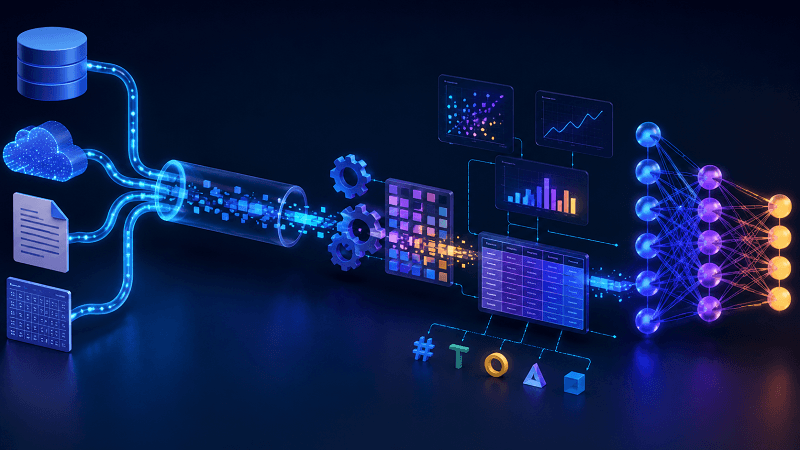
Machine learning discussions often begin with models. Teams compare algorithms, debate architectures, and look for ways to improve accuracy. In a real production system, however, the model is only one part of a much larger process.
Before a model can make a useful prediction, data has to be collected, cleaned, transformed, and delivered in a form the model can understand. Features need to represent the problem correctly. Training must be repeatable, measurable, and connected to the environment where the model will eventually run.
This is why machine learning projects are better understood as systems rather than isolated models. Data pipelines, feature engineering, and model training are closely connected. A weakness in one stage usually affects everything that follows.
What is a machine learning data pipeline?
A machine learning data pipeline is the process that moves data from its original sources to the systems where it can be used for training or inference. Depending on the project, those sources might include application databases, CRM systems, sensors, transaction records, APIs, log files, or third-party datasets.
A basic pipeline may look simple:
Data source → ingestion → validation → transformation → storage → model
In practice, each step introduces decisions. How often should new data arrive? What happens when a source changes its schema? How should missing values be handled? Can historical records be reproduced exactly six months later?
These questions become especially important once a model leaves experimentation. A data scientist may be able to manually clean a dataset for an early prototype, but that approach does not work when predictions depend on thousands or millions of new records arriving continuously.
For companies building production systems, ML engineering and consulting often involves much more than choosing an algorithm. It can include designing reliable data flows, defining features, creating reproducible training processes, and making sure the entire system can be maintained after deployment.
How does data move through a machine learning pipeline?
Most ML pipelines contain several distinct stages, although the exact architecture depends on the business problem.
How is data collected for machine learning?
The first stage is ingestion. Data may arrive in batches, such as a nightly export from a business system, or as a continuous stream of events.
Batch processing is often sufficient for models that do not require immediate updates. A demand forecasting system, for example, might retrain once a week using recent sales data. A fraud detection system may need streaming data because decisions have to be made within seconds.
The important question is not whether batch or streaming technology is more advanced. It is whether the data delivery method matches the speed of the business decision.
How is machine learning data validated?
Raw data should not be assumed to be correct. Columns disappear. Units change. Categories are renamed. Sensors fail. A software update may suddenly change how an event is recorded.
Validation rules help detect these problems before they reach the model. A pipeline might check:
- whether required fields are present;
- whether values fall within expected ranges;
- whether data types have changed;
- whether the volume of incoming records is unusual;
- whether the distribution of an important variable has shifted.
Without these checks, a pipeline can continue running successfully while feeding the model bad data. From an infrastructure perspective, nothing has failed. From a business perspective, the predictions may already be unreliable.
How is raw data transformed for machine learning?
Most raw business data is not immediately suitable for a model. Dates may need to be converted into useful time-based variables. Duplicate records may need to be removed. Categories may need encoding, and numerical values may require normalization.
The transformation stage creates a consistent dataset that can be used by later parts of the system.
Consistency matters here. If one transformation is applied during training and a slightly different version is used when the model receives live data, performance can deteriorate even when the model itself has not changed.
What is feature engineering in machine learning?
A feature is an input variable used by a machine learning model. Feature engineering is the process of turning available data into variables that better represent the problem being solved.
Suppose a company wants to predict whether a customer will cancel a subscription. The raw database may contain login timestamps, invoices, support tickets, plan details, and account information.
The model could receive some of those values directly. But more useful features might include:
- number of logins during the past 30 days;
- percentage change in usage over three months;
- number of unresolved support tickets;
- days since the last product interaction;
- number of failed payments in the past year.
These features capture patterns that raw records do not express clearly.
Feature engineering is therefore partly technical and partly based on domain knowledge. Someone has to understand what behaviour may actually matter.
Why does feature engineering matter so much?
A more complex model cannot always compensate for weak inputs.
Imagine predicting equipment failure using only the latest temperature reading. A sophisticated algorithm may still struggle because the current value says little about how the machine has behaved over time.
Features such as the seven-day temperature trend, frequency of abnormal readings, or time since the last maintenance event may provide much more useful information.
This is one reason model performance cannot be separated from data quality. Teams sometimes spend weeks tuning hyperparameters when the larger improvement would come from creating better features.
At the same time, feature engineering can introduce serious mistakes. One of the most common is data leakage.
What is data leakage in machine learning?
Data leakage happens when a model receives information during training that would not actually be available when a real prediction is made.
For example, a model predicting whether a loan will default cannot use information recorded after the default occurred. A churn model should not use an account status that was updated only after the customer cancelled.
Leakage can produce excellent validation results and a disappointing production model. The model appears intelligent because it has effectively been given part of the answer.
A useful rule is to ask one question for every feature: Would this exact information be available at the moment the prediction needs to happen?
If the answer is no, the feature probably should not be used.
How does model training work in a production ML system?
Model training is the stage where an algorithm learns patterns from historical data. The dataset is usually divided into separate subsets for training, validation, and testing.
The training set is used to fit the model. Validation data helps compare approaches and tune parameters. The test set provides a final evaluation on data the model has not used during development.
The principle sounds straightforward, but the way data is split matters.
For time-dependent problems, randomly mixing old and new records can create unrealistic results. A forecasting model should generally be trained on earlier periods and evaluated on later ones. This better reflects how the system will operate after deployment.
The same concern applies when multiple records belong to the same customer, device, patient, or account. If closely related records appear in both training and test sets, the evaluation may overstate how well the model generalizes.
What should be tracked during model training?
A production training process should produce more than a model file. Teams need enough information to understand exactly how a model was created.
Useful records typically include:
- the dataset or data version used;
- feature definitions;
- model configuration;
- hyperparameters;
- code version;
- evaluation metrics;
- training date;
- environment and dependency versions.
This creates reproducibility. If a model performs unexpectedly three months later, the team can investigate what changed instead of trying to reconstruct the experiment from memory.
Experiment tracking also makes comparisons more meaningful. Without it, teams can end up with files named things like model_final_v2_new_really_final, with little evidence of which version should actually be deployed.
How do data pipelines and model training work together?
The three areas are not separate steps that can be designed independently.
The data pipeline determines what information reaches the system. Feature engineering determines how that information is represented. Training determines how the model learns from it.
A change upstream can affect everything downstream.
Consider a retailer that changes how product categories are stored. The data pipeline may continue running, but a feature based on category history could change its meaning. That change can alter the distribution of model inputs and reduce prediction quality.
For this reason, mature ML systems treat data and feature changes with some of the same discipline used for software changes. Transformations are versioned, tests are automated, and important distributions are monitored.
What is the difference between a training pipeline and an inference pipeline?
The training pipeline prepares historical data and creates a model. The inference pipeline uses that model to generate predictions from new data.
These pipelines share logic, especially around feature transformations, but they have different requirements.
Training may process millions of historical records over several hours. Online inference may need to return a prediction in milliseconds. Training might run weekly, while inference runs continuously.
The challenge is keeping both environments consistent.
If a customer’s “30-day purchase frequency” is calculated one way during training and another way in production, the model receives different information from what it learned on. This problem is often called training-serving skew.
Reusable transformation logic and clearly defined feature calculations help reduce that risk.
How do you know when an ML pipeline needs to be rebuilt?
Not every problem requires a complete redesign. Sometimes a pipeline only needs better monitoring or a more reliable transformation step.
However, recurring warning signs should not be ignored. These include frequent manual fixes, unexplained differences between experiments, long retraining cycles, features calculated differently across teams, and models that perform well in notebooks but poorly after deployment.
Another warning sign is fear of change. If updating one data source could break several models and nobody knows exactly how, the system has accumulated technical debt.
The goal is not to build the most complicated ML platform possible. It is to create enough structure that the system remains understandable as data, models, and business requirements change.
What makes a machine learning pipeline reliable?
A reliable ML pipeline is not defined by a particular cloud platform or orchestration tool. It is defined by predictable behaviour.
The system should make it possible to answer practical questions: Where did this data come from? Which transformations were applied? Which features were used? Can this model be reproduced? What changed between two versions? Will the team know if incoming data becomes abnormal?
Those questions are less exciting than choosing a new model architecture, but they often determine whether machine learning creates lasting business value.
The strongest ML systems are rarely built around a model alone. They connect reliable data pipelines, carefully designed features, reproducible training, and production monitoring into one process. When those foundations are in place, improving the model becomes much easier—and deploying it becomes far less risky.