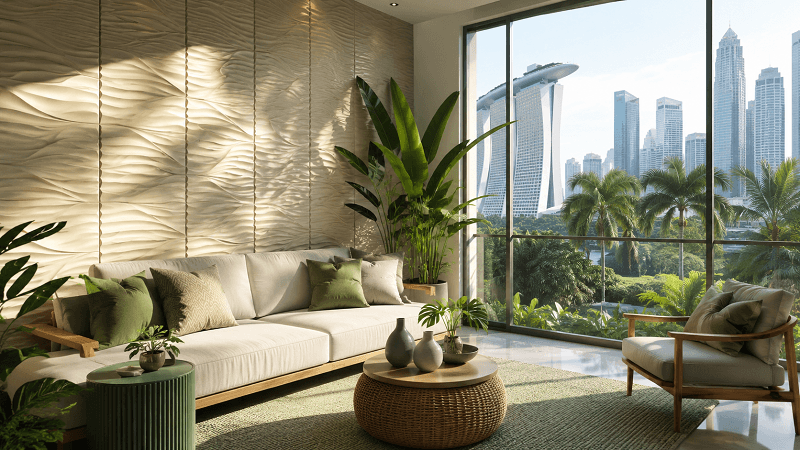
Singapore maintains consistently high temperatures and elevated moisture levels throughout the year. Average relative humidity often ranges from 70 to 95 percent, while daily temperatures stay between 24 and 32 degrees Celsius. These conditions create ongoing pressures on interior surfaces that differ markedly from those in temperate regions. Wall coverings must therefore perform under persistent vapor exposure, temperature differentials from air conditioning, and periodic heavy rainfall.
Homeowners and designers respond by prioritizing materials that limit moisture retention, inhibit microbial growth, and maintain structural integrity over time. The result is a deliberate approach to selection that balances appearance, durability, and indoor environmental quality.
The Persistent Challenges of Tropical Conditions
High ambient humidity allows water vapor to settle on cooler surfaces. Air-conditioned rooms frequently produce condensation when warm outdoor air contacts chilled walls near windows or cooling units. This effect intensifies during monsoon periods from November to March and June to September, when consecutive rainy days push humidity higher and extend drying times.
Mold growth accelerates once relative humidity exceeds 60 percent on surfaces that remain damp. Spores settle in microscopic pores of paint or paper-based coverings. Without intervention, colonies expand in corners, behind furniture, and in rooms with limited airflow. External-facing walls in HDB flats and condominiums show particular vulnerability because temperature swings between interior cooling and exterior warmth promote repeated cycles of condensation and evaporation. These issues often prompt consideration of wallpaper Singapore when seeking finishes that better withstand local conditions.
Core Principles Guiding Material Choices
Smart decisions begin with an assessment of each space. Bathrooms, kitchens, and utility areas require higher resistance because they generate additional moisture from daily activities. Living rooms and bedrooms maintained at stable temperatures through air conditioning allow slightly broader options, provided condensation risks near windows receive attention.
Key performance criteria include low water absorption, active inhibition of fungi, cleanability, and compatibility with concrete or plasterboard substrates common in Singapore housing. Breathability remains important so that any vapor entering the wall assembly can escape rather than accumulate behind the finish layer. Durability under repeated cleaning supports long-term appearance in households with children or frequent use.
Preparation steps influence outcomes. Walls must reach full dryness before application, a process that can take longer in local humidity. Suitable primers seal porous surfaces and improve adhesion. These measures reduce the chance that underlying moisture issues surface later.
Coatings Designed for Local Conditions
Interior paints formulated for tropical use incorporate biocidal additives that interfere with mold and bacterial reproduction on the surface. These agents continue working for the lifespan of the coating without requiring frequent reapplication. Formulations that encourage water to bead rather than penetrate reduce the damp substrate mold requires.
Sheen level affects performance. Satin and semi-gloss finishes create smoother, less absorbent films that withstand wiping better than flat paints. They suit hallways, family rooms, and moderate-humidity zones where occasional cleaning occurs. In wet areas, higher-gloss options provide maximum resistance and ease of maintenance, though they highlight minor surface imperfections more readily.
Specialized anti-condensation coatings add thermal resistance to the surface. By reducing temperature differences between the wall and surrounding air, these products limit droplet formation on chilled surfaces. Locally developed options address exactly the condensation patterns observed in air-conditioned Singapore homes.
Wallcoverings That Withstand Humidity
Vinyl wallcoverings with integrated anti-fungal treatments and stable non-woven backings offer greater resilience than paper products. The surface layer resists absorption while permitting controlled vapor transmission in well-specified systems. Quality versions maintain adhesion even when occasional condensation occurs, provided walls were properly prepared.
For feature walls or higher-wear zones, composite panels provide alternatives. Wood-plastic composite panels combine a wood-like appearance with complete resistance to swelling, warping, or rot. Stone-plastic composite panels deliver rigid dimensional stability and full waterproofing, making them suitable for bathrooms or kitchens. Both types install efficiently over existing substrates in many renovation scenarios and require minimal ongoing upkeep.
These options shift decisions away from frequent replacement cycles toward longer service life. They suit households seeking reduced disruption during future updates.
Emerging Passive Regulation Technologies
Certain materials go beyond simple barriers by actively managing moisture. Hygroscopic plasters based on clay or mineral compositions absorb excess vapor during periods of high humidity and release it when conditions moderate. This buffering stabilizes indoor relative humidity levels within a narrower range, which can lessen the load on mechanical dehumidification in moderate applications.
Advanced coatings under development or available incorporate mechanisms that capture and release water vapor in a controlled manner. Nanotechnology-enhanced finishes add air-purifying functions by breaking down certain airborne compounds at the surface. Heat-reflective properties in some formulations contribute to lower cooling demands by reducing heat gain through walls.
These technologies represent incremental steps toward surfaces that respond to environmental conditions rather than remaining inert. They complement rather than replace proper ventilation and humidity control practices.
Supporting Measures That Extend Performance
Material performance improves when paired with consistent environmental management. Exhaust fans in bathrooms and kitchens remove moisture at the source. Dehumidifiers maintain indoor levels below critical thresholds during extended wet weather. Furniture positioned with clearance from walls allows air circulation. Periodic inspection identifies early discoloration or musty odors before colonies establish widely.
These practices do not substitute for appropriate coverings but prevent conditions that would overwhelm even well-chosen finishes.
Results of Climate-Conscious Selection
Homes that incorporate humidity-resistant and antimicrobial wall coverings show lower rates of visible degradation and associated remediation needs. Interiors retain intended finishes for extended periods, reducing the frequency and cost of redecoration. Indirect benefits include more stable indoor conditions that support comfort and potentially lower energy use for cooling or dehumidification.
In Singapore’s setting, these outcomes reflect practical adaptation to unchanging environmental factors. Choices grounded in local performance data produce resilient spaces that maintain both function and quality over years of continuous exposure. Designers and homeowners who apply this understanding achieve results aligned with the demands of tropical living rather than imported assumptions from different climates.