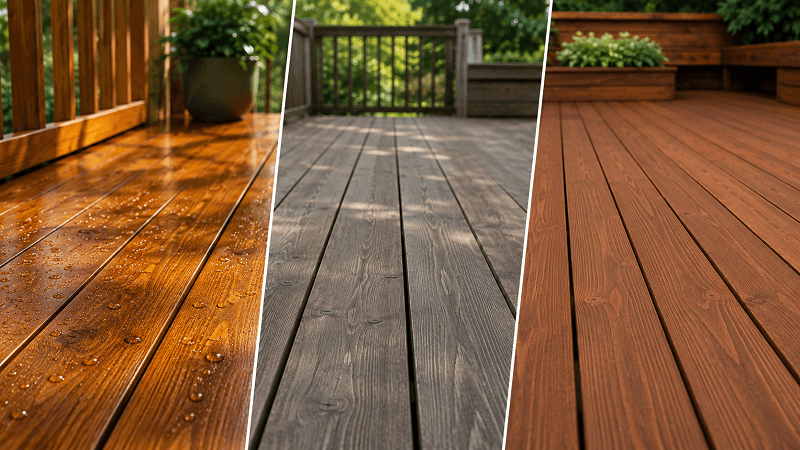
The decision that most often determines whether a deck stain lasts three years or seven is not the color, the brand, or the application technique. It is the chemistry. Oil-based stains, water-based stains, and solid stains are three fundamentally different products that behave differently on wood, weather differently in Ontario’s climate, and require different maintenance schedules to keep performing.
Many homeowners do not realize how consequential this choice is until they have committed to a product that does not suit their deck. By that point, switching becomes difficult. Solid stains in particular can be almost impossible to remove cleanly once applied. Choosing well the first time matters.
Whether you are tackling the project yourself or hiring a professional deck staining Toronto team, understanding what each stain category actually does, and what its strengths and weaknesses are, is the most useful preparation you can do before a single drop of product touches your wood.
Oil-Based Stains: Penetration and Patina
Oil-based stains work by penetrating into the wood fibres. The carrier oils, typically linseed, tung, or synthetic alkyds, carry pigment and resins into the surface and bond with the wood cell structure. The finish is part of the wood rather than a film on top of it.
This is the traditional approach to deck finishing, and it has clear advantages. Oil-based stains let the grain and texture of the wood show through, which suits decks made of cedar, mahogany, ipe, or other woods chosen specifically for their natural appearance. The finish weathers gracefully rather than failing dramatically. When the stain begins to wear, it fades evenly rather than peeling or flaking.
The trade-offs include longer drying times, stronger odor during application, and greater sensitivity to moisture during the curing window. Oil-based finishes also tend to darken over time as the carrier oils oxidize, which some homeowners love and others find disappointing if they expected the original color to persist.
For maintenance, oil-based stains are the easiest of the three categories. A simple cleaning followed by reapplication every two to four years restores the finish without needing to strip the previous coat.
Water-Based Stains: Convenience and Color Stability
Water-based stains, sometimes called latex or acrylic stains, work differently. They form a thin film on the surface of the wood rather than penetrating deeply. The film carries the color and provides UV and moisture protection, and the underlying wood is mostly sealed from above rather than treated through.
The advantages of water-based products have grown significantly. Modern formulations cure faster, smell less, clean up with water, and resist UV-induced color fading better than most oil-based alternatives. Color stability over time is often the strongest argument for water-based stain. A water-based stain applied today will look much closer to its original color three years later than an oil-based product will.
The disadvantages show up in two places. First, water-based finishes are more sensitive to surface preparation. Any contaminants on the wood will prevent proper adhesion, which means cleaning and sanding need to be more thorough than they would for an oil-based product. Second, water-based stains can peel rather than fade when they fail. Peeling requires stripping and full reapplication, which is a much bigger project than a maintenance recoat.
Solid Stains: Coverage and Commitment
Solid stains, sometimes called opaque stains, behave almost like paint. They contain heavier pigment loads and form a thicker film that obscures the wood grain entirely. The finished deck looks more like a painted surface than a stained one, with a uniform color that hides imperfections, age, and previous repairs.
This category serves a specific purpose. For decks that have weathered unevenly, been patched with different wood species, or show damage that the homeowner does not want to address through replacement, solid stains provide the most forgiving cosmetic option. The opacity hides almost everything underneath.
The trade-off is substantial. Solid stains are functionally permanent. Once applied, they cannot be easily reversed. Returning to a natural wood appearance requires complete stripping, often with chemical strippers and significant sanding, and even then the underlying wood may be permanently altered by the process. Many homeowners who applied solid stain on impulse have spent years and significant cost regretting the decision.
Solid stains also fail differently than penetrating products. When the film weathers, it tends to peel and flake rather than fade. Recoating requires removing the failed film first, which is laborious. Maintenance is more involved and more expensive over the deck’s lifetime than maintenance on a penetrating stain.
How to Match the Stain to the Wood and the Climate
The right choice depends on what the deck is made of, what the wood looks like, and how the homeowner uses it.
- Naturally beautiful wood (cedar, ipe, mahogany, redwood) deserves an oil-based or high-quality water-based stain that lets the grain show. Solid stain on these woods is almost always a mistake.
- Pressure-treated pine, the most common deck material in Ontario, accepts all three categories. Oil-based products tend to give the best long-term outcomes because the wood absorbs them readily.
- Older decks with mixed wood, patched boards, or visible aging often suit semi-transparent water-based stains, which provide more color uniformity than oil products while still letting some grain show through.
- Decks the owner intends to repaint or refinish frequently can accept solid stains, since the commitment matters less when the next refinish is also going to be opaque.
Toronto’s climate adds a specific consideration. The freeze-thaw cycles each winter put enormous stress on any finish, and the high-UV summers fade pigments quickly. Stains designed for milder climates often fail prematurely here. According to recent reporting on home maintenance economics, the rising cost of exterior projects in Canadian markets makes choosing a stain that genuinely matches the climate more financially meaningful than ever. Cheaper products often cost more over the deck’s lifetime because they need to be reapplied more frequently.
The Bottom Line
Stain category is the most consequential decision in a deck refinishing project, more important than color, brand, or even application technique. Oil-based products work with the wood. Water-based products protect the wood while letting it show. Solid stains cover the wood entirely and commit the deck to a different category of finish indefinitely.
Choosing the right category for the specific deck, the specific wood, and the specific climate is what separates a finish that performs for years from one that needs to be redone before the next summer. The decision is worth making slowly, with input from people who know the products and the local conditions, before any product goes onto the boards.