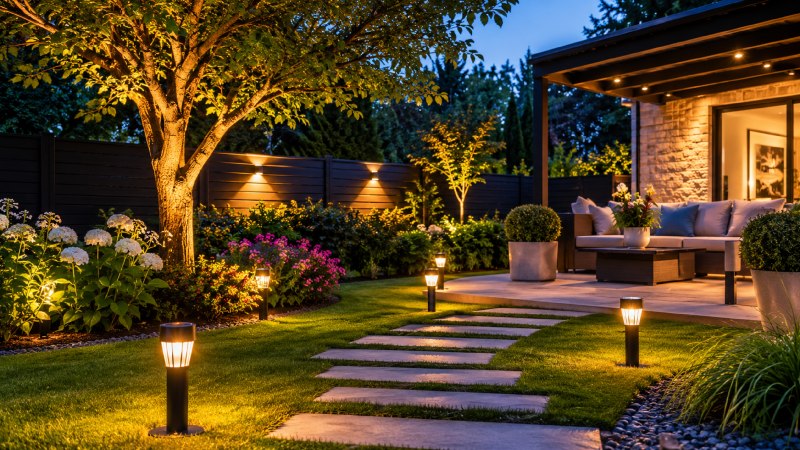
Most garden lighting fails for one reason: people buy fixtures before they decide what the light is for. Decide the job first, then choose the fitting, and a modest budget will go a long way. If you are unsure where to begin, a consultation with Lumos lighting experts can help you map the job of each light before you spend anything.
Key takeaways
- Plan lighting in three layers: path and safety, accent, and ambient.
- Choose warm white (2700K to 3000K) for living areas and avoid harsh cool light near seating.
- LED fittings cut running costs sharply; a typical 10-watt LED uses roughly a tenth of the power of an old 100-watt incandescent for similar output.
- Waterproof rating matters more than brand: look for IP65 or higher for exposed positions.
- Fit a timer or sensor so lights run only when needed.
Start with the jobs the light must do
Path and step lighting carries the most weight because it prevents falls. Place low fittings every 2 to 3 metres along routes you walk in the dark, and keep their output low enough to avoid glare in your eyes. Accent lighting picks out a tree, a wall or a sculpture, and ambient lighting softens the space around the seating area. Treat these as separate decisions rather than one scheme, because each needs a different brightness and beam angle.
Once you know the jobs, count the fittings you actually need. A small courtyard often works well with four to six low fixtures. Buying twenty because a catalogue looked appealing usually means a glaring, cluttered result and a larger electricity bill.
Choose the right colour temperature and beam
Colour temperature changes how the garden feels after dark. Warm white around 2700K to 3000K flatters plants, timber and skin tones, and it suits places where people sit and talk. Cooler light above 4000K can look clinical and makes foliage appear grey, so reserve it for security points if you need them.
Beam angle controls where light lands. A narrow beam of 15 to 25 degrees gives dramatic accents on a single tree. A wide beam of 60 degrees or more is better for paths and open lawns. Mismatching these is the most common error: a narrow spot on a path leaves dark gaps, while a wide flood on a tree washes out its shape.
Compare power, cost and durability
Before you shortlist fittings, compare the common outdoor light sources side by side. The table below shows the typical trade-offs, so you can match a source to its job rather than defaulting to the cheapest option.
| Source | Typical power | Lifespan (hours) | Best use |
|---|---|---|---|
| LED step or path light | 2 to 5 W | 25,000 to 50,000 | Paths, steps, safety |
| LED spotlight | 5 to 12 W | 25,000 to 50,000 | Trees, walls, features |
| Solar stake light | Under 1 W | Around 1,000 to 3,000 | Decorative edging only |
| Halogen floodlight | 50 to 150 W | Around 2,000 | Largely superseded by LED |
Solar stake lights look like an easy saving, but their output is weak and battery life drops after a couple of winters. They suit decoration, not the path you walk at night.
Work out the running cost before you buy
A simple calculation makes the decision concrete. Take a 10 W LED spotlight run for four hours each evening. That is 40 Wh per night, or 14.6 kWh per year. At a tariff of 0.30 per kWh, the annual cost is about 4.40. The same light as a 100 W halogen would use ten times that energy and cost roughly 44 a year, before counting the bulb replacements. Multiply by the number of fittings and the gap becomes significant.
Durability matters as much as efficiency. Check the IP rating, which signals resistance to dust and water. IP44 suits sheltered spots, while IP65 or higher is the sensible minimum for exposed ground fittings that will meet hosepipes and heavy rain.
Install safely and sensibly
Mains-voltage outdoor wiring should be installed by a qualified electrician, and buried cable should run at the correct depth and be protected. Low-voltage systems, typically 12V, are far safer for DIY work and are common for garden paths. Any installation near water, such as a pond or pool, needs extra care, and you should follow local regulations on bathing areas and outdoor circuits.
The real risk with garden lighting is electrical shock from damaged cable or poor connections exposed to water. Never leave joints unprotected, and switch off at the consumer unit before working on any circuit. If a fitting flickers, feels warm or shows scorching, turn it off and have it inspected before using it again.
Build a scheme you can extend
Start with one clear zone, such as the path to the back door, and live with it for a few weeks before adding more. You will learn which fittings are too bright and where shadows fall badly. For ideas on how lighting links the house to the garden, see our guide on How to Master Garden Interior Design: Expert Tips for Indoor-Outdoor F, which covers how the two spaces read together after dark.
Lighting that suits the way you use the garden is cheaper to run, safer to walk and far more pleasant to sit in, so plan for the jobs first and add the features last. Where you need to light a darker part of the home or garden room from above, a guide to Maximising Small Footprints: Velux Skylights to light up the inner-cit shows how daylight and night-time lighting can work together.