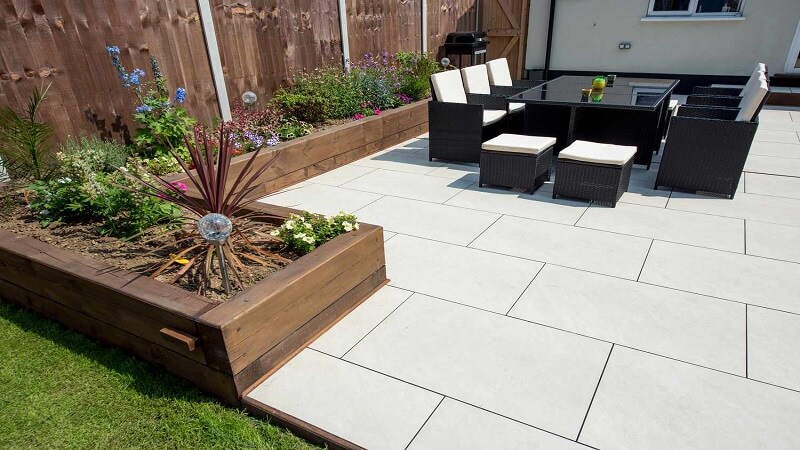
Not every tile that looks good on the shelf will look good in a yard three years from now.
Outdoor surfaces are tested daily by the full range of conditions that indoor materials never face: sun, frost, rain, heat cycles, foot traffic, and the slow, persistent pressure of moisture working its way into every micro-crack.
A material that passes all of those tests without losing its design integrity is genuinely rare.
OUTERclé is a specialist outdoor tile collection built specifically around that challenge. Their approach starts with a question that many tile brands skip: what does the outdoor environment actually demand from a surface, and which materials can honestly meet those demands at the level of both performance and design?
Drawing on OUTERclé’s material expertise, this guide sets out the three qualities that distinguish a great outdoor tile from one that simply looks the part, and explains how those qualities apply across the different zones of a modern yard.
The three-part test every outdoor tile must pass
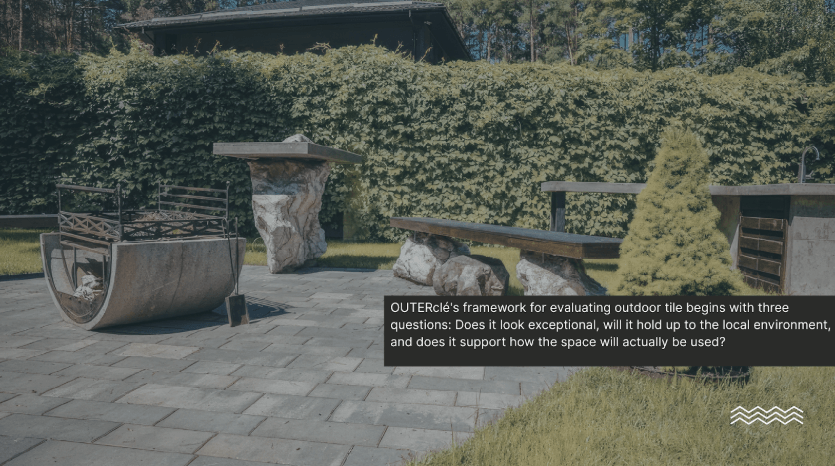
OUTERclé frames the decision clearly: the best outdoor tile is not a single material chosen for appearance alone. It is a three-part promise. The tile must look exceptional, stand up to the local environment, and function correctly for how the space will be used. Any tile that only delivers on one or two of those three dimensions is the wrong choice, regardless of how good it looks on day one.
1. Design Integrity Comes First
Design integrity means material honesty, not decorative surface.
A tile with real visual quality has genuine depth in its colour, character in its surface, and a presence that holds up to close inspection rather than flattening out at distance.
Handcrafted tiles, with their natural variation in tone and texture, tend to carry this quality in a way that uniformly produced surfaces do not. The slight differences between adjacent tiles are what give a finished surface its visual richness.
2. Durability Depends on the Environment
Durability is where material science matters. OUTERclé’s emphasises that materials respond differently to climate: porous tiles that absorb water can crack in freeze-thaw conditions; dark dense stone can become uncomfortably hot in full sun and may fade; coastal environments add salt corrosion and grit to the equation. The right material is always matched to the specific conditions of the site, not chosen from a generic list of options.
3. Function Determines Long-Term Success
Function covers slip resistance, heat gain, and maintenance. A beautifully specified patio tile that becomes dangerously slippery when wet has failed its brief.
A premium natural stone surface that requires resealing every six months is not a low-maintenance solution regardless of its visual quality.
Understanding these dimensions before purchasing is the difference between a specification that serves the homeowner for a decade and one that creates problems within the first season.
Material character versus material performance: why both matter equally
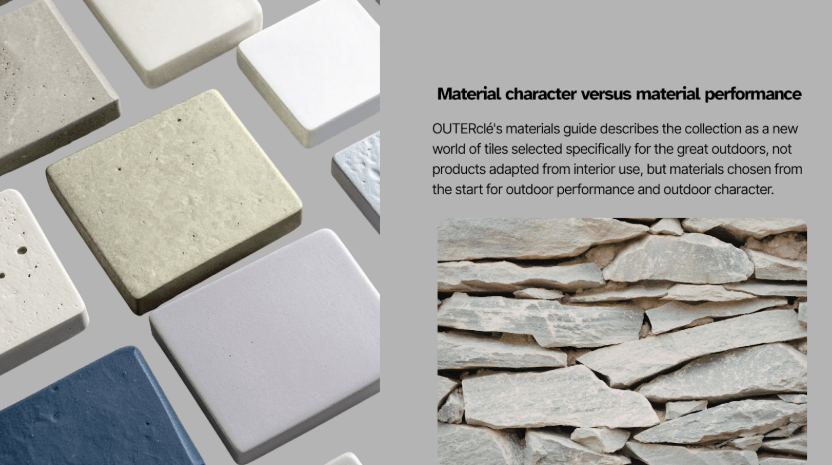
What separates OUTERclé’s approach from standard outdoor tile suppliers is the equal weight given to material character alongside performance.
Their materials guide describes the collection as outdoor design in a whole new way: tiles and surfaces chosen to forge a connection to other worlds, cultures, times and places, weaving history, tradition, and character into the outdoor space. That ambition is not just aesthetic. It is also a specification discipline: selecting materials whose character derives from what they are made of, not from what they are printed to look like.
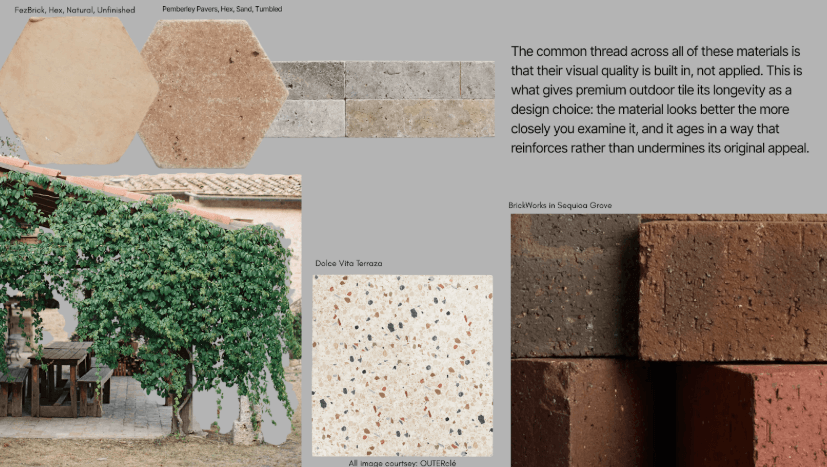
When you browse luxury outdoor tiles for your home through OUTERclé’s curated range, the distinction between materials with genuine surface depth and those with a reproduced finish is immediately apparent.
Terrazo
Terrazzo is a useful example. Its aggregate of marble, quartz, or glass chips runs through the full thickness of every tile, so as the surface weathers over time it continues to reveal the same material composition rather than wearing through to something plain. Cement tile achieves a similar quality through different means: the mineral pigment is pressed into the full depth of the wear layer during production, not applied as a glaze. Both materials improve with age in outdoor conditions rather than simply degrading.
Terracotta
Terracotta brings a different kind of character. Its warm colour comes from the natural iron content of the clay body, not from a surface treatment that can fade. Over time, properly sealed terracotta develops a patina that integrates with the surrounding garden rather than resisting it.
Natural Stone
Natural stone has perhaps the most compelling character of all: geological variation, unique veining, and a surface quality that cannot be replicated by any manufacturing process because it was not produced by one.
Matching tile to yard zone: a practical guide from OUTERclé’s framework
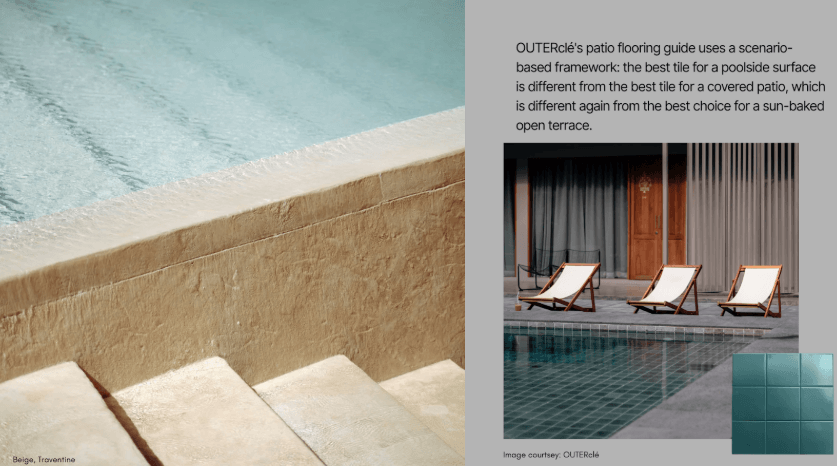
OUTERclé’s guidance on outdoor patio flooring uses a scenario-based concept that is directly applicable to different zones within a modern yard. The framework makes a point that is easy to overlook: there is no single best outdoor tile. There is only the best tile for a specific combination of climate, use, and design intent.
For open, exposed patio surfaces in climates with frost, porcelain pavers or dense natural stone with confirmed freeze-thaw ratings are the most reliable choice. Their low water absorption rate prevents the internal pressure that causes less dense materials to crack over winter. Porcelain in particular offers low maintenance, UV stability, and a consistent surface that reads well in large-format layouts, which have become a defining characteristic of contemporary outdoor design.
For covered outdoor rooms and sheltered terraces, the range of appropriate materials expands significantly. When a surface is protected from direct weather exposure, cement tile, terrazzo, and finer handcrafted ceramic formats become viable and compelling options. A covered patio is also where pattern and colour can be used more confidently, because the surface will not be subjected to the weathering cycles that can make bold choices look tired on a fully exposed area over time.
For hot climates and sun-baked outdoor surfaces, OUTERclé’s guidance specifically notes that light-toned tiles perform better than dark ones: they absorb less heat, remain more comfortable underfoot, and tend to show less UV-induced colour shift over time.
This is a straightforward material science point that is frequently overlooked when tiles are chosen primarily for their visual impact rather than their thermal behaviour.
Poolside surfaces introduce the additional requirement of slip resistance for wet conditions. Textured porcelain and unglazed or matte-finish natural stone are the standard recommendations in this application.
The Dynamic Coefficient of Friction (DCOF) rating is the relevant specification parameter, and any tile used around water should meet the threshold recommended for wet outdoor conditions. Selecting furniture that hold up to harsh seasonal conditions applies equally to tile as it does to garden furniture: climate performance and long-term integrity should always be confirmed before any outdoor surface specification is finalised.
Why premium outdoor tile is a yard investment, not just a design choice
There is a straightforward case for investing in premium outdoor tile that goes beyond aesthetics. A well-specified tile surface installed correctly has a service life measured in decades, not years. The cost-per-year calculation over that period is often lower than a less durable material that requires replacement or remediation within five years, even before factoring in the disruption and labour costs of that remediation.
The design quality argument is equally compelling.
A premium outdoor tile changes the visual register of the entire yard. It sets the level of finish that furniture, planting, lighting, and boundary treatments are perceived against.
A handcrafted cement or terrazzo surface on a patio immediately raises the standard for everything around it, in the same way that a premium interior floor elevates the perceived quality of a room. The inverse is also true: a mediocre outdoor surface makes even carefully chosen furniture and planting look less resolved.
OUTERclé’s materials philosophy treats outdoor tile selection not as a commodity decision but as a design and specification discipline. Their curated approach, applying the same outdoor planning principles that make a yard genuinely functional as well as beautiful, reflects the reality that premium outdoor surfaces are most effective when they are chosen as part of a considered whole-yard design rather than selected in isolation.
The material should respond to the architecture of the home, the climate of the site, and the way the outdoor space will be used, all three at once.
That integration is what separates a yard that looks designed from one that looks assembled. And in a modern yard where outdoor living has become an extension of interior space rather than a supplement to it, the standard that tile must meet is correspondingly higher.
The short answer to a question that deserves a longer one
What makes a great outdoor tile?
According to OUTERclé’s framework, the answer involves three simultaneous commitments: design integrity that comes from material character rather than surface treatment, durability that is matched to the specific conditions of the site rather than a generic outdoor rating, and functional performance that supports how the space will actually be used.
Getting all three right is not complicated, but it does require making material choices in the right sequence.
Performance first.
Then material character.
Then pattern, colour, and format.
That order of priorities is what produces an outdoor surface that will still look purposeful and considered a decade from now, which is the only timeline that matters for a decision this permanent.