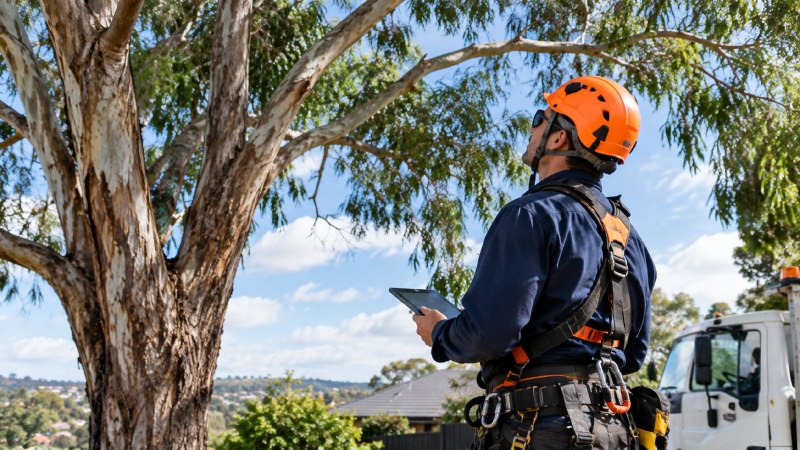
A chainsaw, a ladder and a Saturday afternoon can feel like all you need to sort out that overgrown gum tree. In reality, that combination sends tens of thousands of people to emergency rooms every year, and it is one of the fastest ways to turn a healthy tree into a structural hazard. The real question is whether the job in front of you sits inside the narrow range of tasks that are genuinely safe for an untrained homeowner. Once it falls outside that range, it has already moved into arborist territory.
What tree lopping actually is (and why it’s different from pruning)
Tree lopping is indiscriminate cutting, with branches hacked back to stubs without regard for the tree’s structure, species or long-term health. It is fast and may look tidy for about a month, but it is almost always the wrong call for the tree.
Professional pruning, by contrast, follows an established standard. In Australia, that is AS 4373-2007, which sets out exactly where cuts should be made, at the branch collar rather than mid-limb, and how much canopy can be removed without triggering a stress response. An arborist working to this standard is thinking about the tree’s future structure and how it will respond to each cut. Someone with a chainsaw and no training is generally focused on getting the job done before lunch. The outcomes can be very different, even when the tools appear identical.
The safety numbers are worse than most people expect
The U.S. Consumer Product Safety Commission estimates that chainsaw-related injuries send around 36,000 people to emergency rooms in the United States every year, many with serious hand, leg and head trauma (CPSC). That figure does not come from a niche industry report. It is a widely cited benchmark in occupational safety literature, and it reflects what can happen when untrained operators pick up a saw without fully understanding its force or behaviour.
Chainsaw kickback is the single biggest cause of these injuries. It happens quickly, affects experienced users as well and is far more likely when someone has not been trained to read the bar angle and cutting force. Add a ladder into the mix, or worse, climb the tree without a rope, harness or spikes, and a serious fall risk sits on top of the laceration risk. Falling limbs create another category of injury entirely, especially when a “let it fall where it falls” approach meets a fence, a car or a person standing where a controlled drop zone should have been established.
What lopping does to the tree itself
Most DIY guides skip an important point: even if nobody gets hurt during the work, lopping can damage the tree in ways that only become visible months or years later.
Trees respond to wounds through a process called CODIT, or compartmentalisation of decay in trees. A clean, correctly placed cut allows the tree to wall off the wound and helps prevent decay from spreading inward. A stub cut, or a cut made in the wrong place, disrupts that natural defence. The wound remains open for longer, decay gains a foothold and the trunk can begin rotting from the inside while the exterior still appears healthy. By the time obvious symptoms develop, the underlying damage may already be well established.
At the same time, heavy lopping strips away much of the tree’s photosynthetic canopy. The stressed tree responds by producing epicormic shoots, which are fast, weak regrowth that is poorly attached to the parent branch. It can look like recovery at first. In practice, it creates a liability because those shoots are exactly the kind of growth that can snap off in high wind, and Toowoomba’s storm season is not gentle. A tree that has been lopped hard is more likely to drop limbs during the next severe weather event, rather than less likely.
Council rules and the permit trap
Toowoomba Regional Council local laws protect significant and native vegetation on private property, and unauthorised removal or lopping of a protected tree can attract fines and a restoration notice. Homeowners often assume that a tree growing on their own block is entirely theirs to deal with as they choose. That is not always the case, particularly when local protections apply to the tree or vegetation concerned.
If a tree falls under a protected category, obtaining a permit almost always requires an arborist’s report, which means you are paying for professional input either way. Completing the work first and asking questions later is the expensive way to discover that the tree was protected. It can also leave you dealing with both the original tree problem and the consequences of unauthorised work.
The insurance trap nobody mentions
This problem tends to catch people after the work has already been done. If a DIY-lopped branch comes down on a neighbour’s fence, car or roof, your home insurer may decline the claim because the work was carried out by someone unqualified. Public liability cover for tree work generally assumes that the person doing the cutting holds the appropriate credentials. Once that assumption no longer applies, the cover may no longer apply either, leaving the homeowner personally responsible for the resulting costs.
A licensed arborist carries their own public liability insurance and workers’ compensation, which means damage caused during a professional job is properly covered and the liability does not fall back on your policy. That is a material difference, not a minor technicality hidden in the paperwork. It is worth confirming the cover before any cutting starts rather than trying to establish responsibility after something has gone wrong.
Powerlines: the line you cannot cross yourself
If any part of the job involves branches near overhead powerlines, stop. Queensland’s electrical exclusion zone rules require a minimum three-metre approach distance for vegetation work near powerlines, and only licensed arborists with the appropriate accreditation are permitted to operate inside that zone. This is the difference between a routine tree job and a potential fatality. Every year, people are seriously injured or killed while attempting exactly this kind of “quick trim” near a line they assumed was far enough away. A homeowner with a pole saw should never take on this work, regardless of how manageable the branch looks from the ground.
The honest cost comparison
DIY lopping looks cheaper until all the actual costs are included. Chainsaw hire or purchase, personal protective equipment, a chipper or green waste disposal fees and stump grinding if the tree is removed entirely can add up quickly, even when nothing goes wrong. Add the cost of replacing a mature tree that has been accidentally killed by poor cuts, or repairing a neighbour’s fence after an uncontrolled drop, and the supposedly cheap DIY option can cost more than a professional quote would have from the start. That comparison also excludes the personal cost of an injury and the time required to manage the work safely.
This is often the point when homeowners in Toowoomba realise that the safer move is to call someone qualified for tree lopping toowoomba rather than pushing ahead alone, particularly once powerlines, property boundaries or a tree more than a few metres tall are involved. The quote may feel like an extra expense at the time. In most cases, it is considerably cheaper than dealing with an injury, property damage or a compromised tree afterwards.
Where DIY is genuinely fine
None of this means that every branch requires a professional. There is a real and defensible category of DIY-safe work, provided the task remains small, accessible and well clear of other hazards.
Young saplings within arm’s reach, pruned at shoulder height with hand tools, are a reasonable task for a homeowner. The same applies to removing small dead twigs under about 5cm in diameter, provided you are working away from structures and powerlines and using basic PPE such as gloves, safety glasses and a helmet if there is any chance of falling debris. If the branch is thin, low, clear of everything else and reachable without a ladder, the job remains inside reasonably safe DIY territory.
When any of those conditions changes, whether through increased height or diameter, the presence of a powerline, or signs of decay or dieback, the job has moved beyond DIY range. A simple mental checklist can help you assess the task: consider the overall size, branch diameter, proximity to powerlines or structures, species behaviour and the tree’s current health. If two or more of those factors raise a concern, the work should be treated as an arborist’s job.
How to vet a professional before they touch a chainsaw
Not every business advertising “tree lopping” is staffed by qualified arborists, so it is worth asking several direct questions before accepting a quote or allowing work to begin.
Look for current AQF Level 3 (Climbing Arborist) accreditation at minimum, with AQF Level 5 (Advanced Diploma) for more complex or high-risk jobs. Ask for a copy of the operator’s public liability insurance certificate before work starts, rather than after. A properly managed business will provide a written, site-based quote instead of a rough verbal figure, and its staff should be able to direct you to other local jobs or references. Arboriculture Australia membership is also a reasonable signal, since it generally indicates that the operator is keeping up with current standards and safety practices instead of relying on habits learned decades ago.
A good arborist will explain what they are planning to do and why, including the difference between crown reduction to manage size and wind load and outright topping, which uses stub cuts that destroy the tree’s form and create the same epicormic regrowth problem as DIY lopping. If a quote appears to offer a “quick lop and go”, treat that wording as a warning sign rather than a bargain. A competent operator should be able to describe the intended result for the tree, not merely how quickly the branches can be removed.
Where the risk actually sits
The line between a reasonable weekend task and a genuine hazard is determined by height, weight, proximity to power and what happens to the tree’s structure after the cut, rather than confidence with a chainsaw. Get those variables right and a small job stays small. Get them wrong and the result may be an ER visit, a council notice, a declined insurance claim or a dead tree that was healthy a year earlier. The homeowners who come out ahead are not necessarily those who avoid every cut themselves. They are the ones who recognise exactly where their own competence ends and bring in a qualified arborist before the risks exceed it.