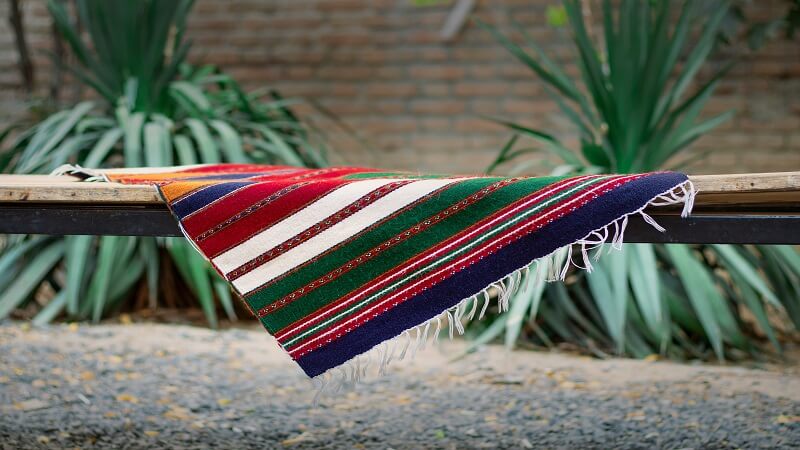
Warm and cozy, but not too fussy – this is what many sunrooms are aiming for. Mudrooms will want durability and resilience underfoot. A rug may help achieve these aims, though not necessarily the same type for both spaces.
All of these natural fibers will add a lovely organic element. They’ll complement other features of the room such as greenery and exposed wood, metal or stonework.
Of course, some are better suited to certain areas than others. You don’t want to leave a natural fiber perpetually saturated outside your back entrance!
What this article covers:
- Benefits of natural fibers
- Differences between Sisal and Jute
- Styling your Sunroom
- Rugs for a Mudroom
- How “eco” can a rug be?
- Care of Natural Fiber Rugs
- Summary
Benefits of natural fibers
Jute, Sisal, Coir, Sea Grass and others fall under the natural fiber category. All will introduce subtle variations of hue to an area.
This can be very beneficial, particularly if there are large areas of tile, windows, and other plain colored walls. Not only will it soften and add interest, but it will also anchor your seating.
Each natural fiber is unique, as explained below. For example, jute is harvested from the stalks of a plant, whereas sisal is derived from the leaves. These are just some of the factors which determine characteristics of the final product.
Finally, as you’d expect, none are impervious to water. All are susceptible to varying degrees of absorption and should be sited accordingly.
Differences between Sisal and Jute
There are obvious visual differences between sisal and jute. However, the most important consideration is still the function of that particular area.
As a general rule, sisal is quite hard-wearing with a coarser hand. It is therefore suitable for high-traffic areas, most likely with footwear on. Prolonged contact with pools of liquid should be avoided.
Conversely, jute is rather plush and supple, with a softer feel under bare feet. It can therefore lend a coziness to an area, especially one where you might sit or recline.
You may wish to lay jute rugs under seating in your sunroom to create a more liveable atmosphere. Alternatively, a denser sisal would be appropriate leading into the house from an external door, as long as it’s reasonably protected from the elements.
Obviously, many variables will play a part, from family members and pets to footwear, so assess what this area of your home needs.
Styling your Sunroom
As discussed, presumably you’ve created this room to enjoy views and the great outdoors. You’ll therefore want to furnish it in a way that encourages you to relax and spend as much time as possible there.
Laying down a rug is a great way to create a focal point, whether that’s a pair of armchairs with a side table, or to extend the feel of adjoining seating. Try not to tuck too much of the rug underneath, to take full advantage of its attractive weave.
You’ll probably opt for neutral shades of cream, beige or light brown. These will all blend in nicely with surrounding vegetation and natural timber. Should you find a preponderance of similar colors, introduce some stronger hues elsewhere, for example on accessories.
Bear in mind that extended periods of direct sunlight will have a detrimental effect. Where possible, move it around periodically, or deploy window coverings.
As a precaution, you may also wish to place any potted plants on a saucer, away from the rug.
Rugs for a Mudroom
Clearly, you’ll want something more robust to withstand the elements brought in by family and pets.
It’s sensible to lay an appropriate, machine-washable mat at the threshold, and only deploy a natural fiber beyond this point, assuming it’s generally kept free from excess moisture.
By dividing up the space into zones, as described, you can benefit from the attractive qualities of these rugs.
You may choose a relatively flat weave, such as sisal, in this area. Avoid protruding fringes or raised borders to help prevent tripping hazards.
Other points to consider:
- Site appropriately, avoiding overlap with opening doors or protrusions, such as a built-in seat
- Fit a suitable underlay
- Avoid leaving wet items on top
- Periodically lift to inspect the sub-surface
Naturally, if conditions dictate that the whole area will be regularly drenched, then a washable synthetic would be preferable.
How “eco” can a rug be?
Obviously, using plant-based raw material has its appeal. According to Textile Exchange, jute made up about 53% of non-cotton plant fibers produced worldwide in 2025. That includes uses beyond rugs and is not a measure of environmental impact.
However, there may be a combination of recycled materials with natural, or other non-renewable sources. In addition, processes involved with dyeing, treatments applied, and methods of shipping may all be relevant considerations.
When considering purchasing ‘green’ products, try to ascertain as much detail as possible regarding composition, manufacture and any accreditations. And finally, consider its suitability and therefore lifespan for its intended application.
Care of Natural Fiber Rugs
As ever, it’s preferable to avoid soiling in the first place by removing loose soil with regular, low-power vacuuming. Adhere to any manufacturer’s recommendations regarding attachments.
In the event of a spillage, absorb as much as possible. Avoid saturating the rug or applying a steamer unless recommended. Excessive moisture may cause distortion and other undesirable effects.
Any stubborn marks should be referred to a professional who is familiar with cleaning natural fibers. The Carpet and Rug Institute recommends professional help for stubborn spills, particularly where ordinary cleaning is not suitable.
Don’t forget to inspect the underside, which may accumulate debris and potentially moisture.
Summary
There are plenty of options available if you’d like to incorporate natural fibers into your home. Simply ensure that you select one suitable for the conditions in each individual room.
Jute rugs are well suited to many low-impact, dry locations, with sisal rugs generally offering greater durability under regular dry foot traffic. Otherwise, a suitable washable product should be chosen.