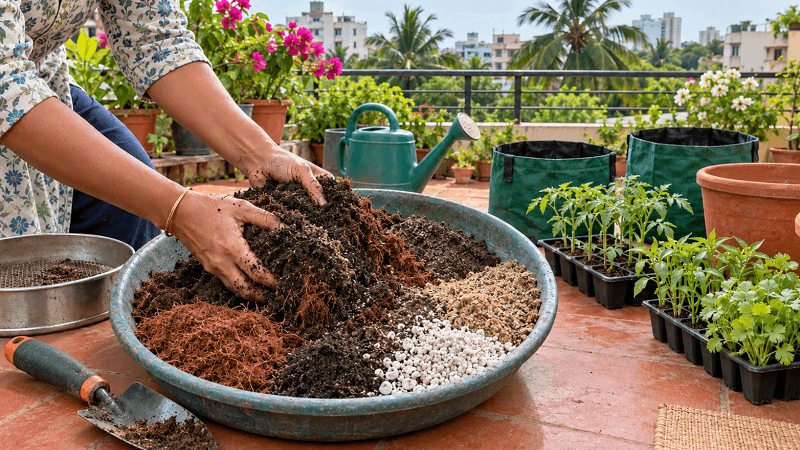
The soil in your garden beds does most of the work. It holds water and nutrients, anchors roots and supports the life that keeps plants healthy. Before summer, it’s worth checking that each bed has the right soil for what you’re growing. A bed with the wrong mix will struggle through the hot months no matter how often you water it.
Why the mix matters
Soil is a mix of mineral particles, organic matter, water, air and living organisms. Agriculture Victoria’s introduction to soil explains how these parts work together. In a garden, the balance between them decides how well soil drains, how much water it holds and how easily roots grow.
Sandy soils drain quickly but dry out fast and hold few nutrients. Clay soils hold water and nutrients well but can become waterlogged in winter and set hard in summer. Most garden plants do best in something in between: a loam with plenty of organic matter that drains freely but still holds moisture.
Match the soil to the plants
| Planting | What it needs | Soil to look for |
|---|---|---|
| Vegetables and herbs | Rich, free-draining, high in organic matter | Vegie or garden mix with compost |
| Native plants | Free-draining, lower in phosphorus | Native or low-nutrient mix |
| Lawns | Fine, even, free-draining | Lawn or turf underlay |
| Raised beds | Light, rich and well structured | Premium garden or raised-bed mix |
| Pots | Lightweight, consistent | Potting mix (not garden soil) |
Many Australian native plants are adapted to low-phosphorus soils, so rich vegetable mixes and some fertilisers can harm them. If a bed mixes natives and exotics, it’s often easier to separate them into different beds with different soils.
Signs your soil needs help
- Water pools on the surface or runs straight off.
- The soil is hard, cracked or compacted.
- Plants are yellowing or growing slowly despite feeding.
- The bed has sunk well below its edges.
- There are few worms or other signs of soil life when you dig.
A simple test is to dig a hole about 30 cm deep, fill it with water and see how long it takes to drain. If water is still sitting there hours later, drainage needs work before you plant.
Preparing beds for summer
- Clear weeds and old plants, including roots.
- Loosen compacted soil with a garden fork, without turning it over completely.
- Add compost or a new soil mix to top up and improve structure.
- Water well and let the bed settle for a few days.
- Plant, then mulch to keep moisture in through the hot months.
For raised beds that have sunk, top up with fresh mix rather than just adding compost, so the bed keeps its structure. For in-ground beds with heavy clay, adding organic matter year after year gradually improves the soil.
Soil for new lawns
If you’re planning to lay turf or sow seed before summer, preparation matters as much as the turf itself. Remove the old grass and weeds, loosen the existing soil, then spread a layer of lawn or turf underlay so the surface is smooth and even. Roll or lightly compact the area, check levels so water doesn’t pool, and water the base before laying turf. New lawns need regular watering in their first weeks, especially if laid as the weather warms up.
Topping up and improving over time
Garden soil isn’t a one-off job. Organic matter breaks down, beds settle and nutrients are used up by plants. Adding a few centimetres of compost each year, mulching beds and rotating crops in vegie patches all help keep soil healthy. Over a few seasons, even poor soil can be turned into a rich, crumbly mix that holds water well and grows strong plants.
Watering in summer
Even the best soil needs the right watering. Deep, less frequent watering encourages roots to grow down into cooler soil, while frequent light sprinkles keep roots near the surface where they dry out quickly. Water early in the morning, and check soil moisture with your finger before watering again.
Bulk or bagged soil?
For filling several beds, a bulk delivery by the cubic metre is usually the most cost-effective option. Bagged soil and potting mix suit small jobs, pots, balcony gardens and places a truck can’t reach. If you’re ordering bulk, clear a spot near the beds for the delivery and have a wheelbarrow, shovel and tarp ready. Covering the pile stops it drying out or washing away if it rains before you’ve finished spreading it. It’s also worth asking whether the mix has been screened, as screened soil is free of large clods and stones and is easier to spread evenly.
How much soil to order
Multiply the bed’s length by its width and depth. A raised bed 2.4 m long, 1.2 m wide and 0.3 m deep holds 2.4 × 1.2 × 0.3 = 0.864 m³. Order a little extra to allow for settling, which is common in the first few weeks as the soil compacts and organic matter breaks down.
Buy local
Soil is heavy, so it makes sense to buy from a supplier close by. In Melbourne, SoilWorx garden soil is available in several mixes from its Deer Park, Pakenham and Werribee yards, in bulk or in bags. Staff can help match a mix to your plants, so your beds are ready to grow through summer.