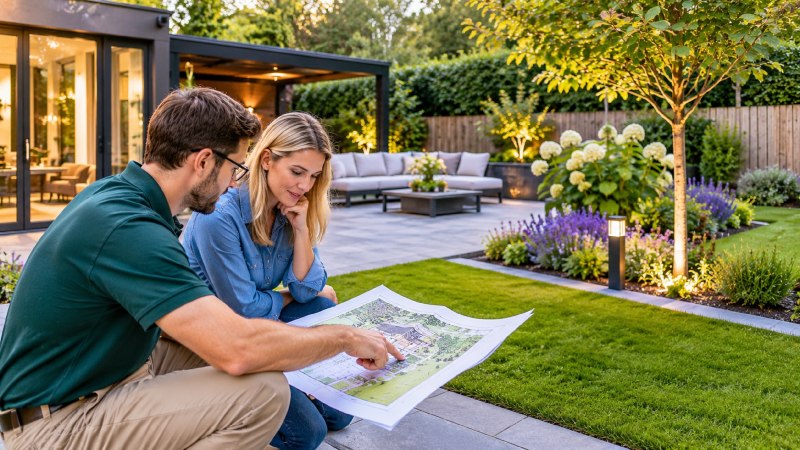
You’ve spent the last three weekends staring at your garden with a cup of tea, convinced that inspiration will strike if you just stand there long enough. So far, the only thing that’s struck is the realisation that you have no idea where to start.
Between the sloped bit near the shed and the patio you laid yourself that now slopes gently towards the house, the whole thing feels like a puzzle with half the pieces missing.
But a professional garden design service will take every one of those problems and turn them into a plan you can actually follow. Here’s what that process looks like, step by step.
The Initial Site Survey and Consultation
Every design starts with someone actually visiting your garden and measuring the space properly.
The design team will check soil condition, test drainage, track how sunlight moves across the plot throughout the day, and note any slopes or level changes that will affect the layout.
They’ll map out the structural elements you want to retain and identify what needs clearing out. A precise measurement strips away the guesswork. That’ll reveal what you actually have to work with—including all the awkward boundaries and tight corners you usually ignore.
Every garden in the UK has its quirks. Maybe yours has a mystery drainpipe from 1974 running under the lawn, or a root system from a neighbour’s oak tree that makes digging anywhere near the back fence a nightmare.
A thorough site survey catches all of that before any design work begins, which saves you from discovering expensive surprises halfway through construction.
The Concept and Master Design Plan
Once the survey data is in, the design team will translate your ideas into a scaled layout. If your brief was something along the lines of ‘I want it to feel like Tuscany but without any actual effort,’ this is where that gets turned into a workable 2D drawing or 3D visual concept.
The plan will divide your garden into functional zones. You’ll see a clear layout for a dining area, a planting scheme for the borders, a play space if you have children, and a sun trap for the warmest corner of your plot.
This also saves you from endless back-and-forth debates about patio sizing. Seeing the layout drawn to scale quickly reveals what actually fits, and what was purely wishful thinking.
You’ll have a visual plan in front of you, and the designer will explain exactly why each element sits where it does based on sunlight, access, and drainage.
Hard Landscaping Specifications
Hard landscaping covers every non-plant structure in your garden. That means patios, decking, pathways, retaining walls, raised beds, pergolas, and steps.
The design team will give you technical drawings with material specifications, drainage gradients, and load-bearing calculations where needed.
Getting this right before a single shovel hits the ground is essential. A patio that hasn’t been graded properly will collect standing water every time it rains. And a retaining wall built without proper footings on a clay-heavy soil will start leaning within a couple of years.
You’ll also have every material choice confirmed in the specifications, so you’ll know exactly what type of stone, timber, or composite is going where. No last-minute substitutions from a builder who ‘couldn’t get the one you wanted.’
Bespoke Planting Schemes
A professional planting plan removes every bit of guesswork from what goes in the ground. The designer will select species based on your soil type, sun exposure, the local climate, and how much time you’re genuinely willing to spend watering and pruning.
You’ll receive a planting map with exact species, quantities, and positions. The scheme will include bloom schedules so you have colour in every season, and the designer will layer heights so tall structural plants sit at the back with ground cover at the front.
You’ll also avoid the trap of buying an expensive specimen plant, only to find it dead three days later because nobody told you it needed full sun and mild winters.
A proper scheme means every plant in your garden will thrive in the conditions you’ve actually got, not the conditions you wish you had.
Lighting and Utility Features
A full garden design service will integrate outdoor lighting, power sockets, irrigation systems, and water feature plumbing directly into the master layout.
These elements get planned alongside the hard landscaping so that cables and pipework run beneath the surfaces before anything is built on top.
Well-placed lighting extends your usable garden hours well into the evening and through the colder months. Uplighters beneath trees, path-level LEDs along walkways, and warm spotlights over a dining area will make your space feel entirely different after dark.
Because trying to locate your wine glass while squinting in the dark, only to realise you’ve almost taken a sip out of a tin of fence paint, is not the ‘atmospheric evening’ you envisioned.
Full Project Management and Build Support
This is where the blueprints turn into real dirt and stone. A managed build means the design team coordinates landscapers, schedules materials, keeps the project on budget, and oversees construction from initial clearance to the final plant.
You won’t need to chase suppliers, negotiate with subcontractors, or spend your Saturday standing in the mud holding a spirit level and discovering that your retaining wall is three inches off alignment. The project manager handles all of that.
Managed builds also guarantee strict quality control at every stage. If a drainage gradient is wrong or a material delivery doesn’t match the specification, it gets flagged and corrected before the next phase of work begins.
You end up with a finished garden that matches the design you approved, built to a standard that will hold up for years.
Conclusion
Huge congratulations on choosing the smart route! You’ve dodged the DIY weekend of dust-covered clothes, crooked paving, and three trips to the garden centre for the wrong gravel.
Now sit back, let the experts do the heavy lifting, and get ready to enjoy a stunning outdoor space you didn’t have to break your back to create.