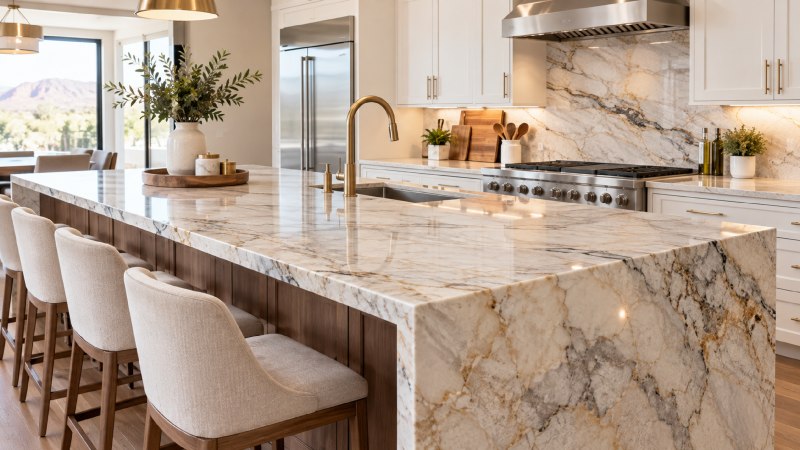
Choosing a countertop is one of the most visible decisions in a kitchen remodel. For St. George homeowners, kitchen quartzite countertops can bring distinctive natural movement and a refined stone appearance to the room, but the right choice depends on more than a favorite color or a small sample.
Carpets Plus Design can help homeowners compare quartzite with quartz, granite, and marble while considering cabinetry, flooring, backsplash tile, lighting, appliances, layout, and maintenance expectations. That broader design process is especially useful when a natural slab will become the visual focal point of the kitchen.
Why Quartzite Requires a Thoughtful Selection Process
Quartzite starts as quartz-rich sandstone and transforms through heat and pressure. In kitchens, it’s valued for its natural character, ranging from soft white and cream to dramatic gray, gold, blue, or charcoal veining. Its uniqueness adds appeal but means no two slabs are identical. Homeowners often confuse quartzite with quartz, but quartzite is a natural stone, while quartz countertops are manufactured with mineral resins and pigments. Both suit kitchens but differ in appearance and care. Understanding these differences prevents choosing based solely on look. Quartzite can mimic marble and provides a durable surface suitable for active kitchens. However, it should be evaluated for absorption, finish, sealing, and fabrication needs. Proper care involves gentle cleaning, quick spill cleanup, and slab-specific sealing.
Comparing Quartzite With Other Countertop Materials
Seeing several material categories in a single design consultation can make the decision more straightforward. Rather than assuming a single surface is best for every home, homeowners can compare the qualities that matter most in their kitchen.
- Quartzite: A natural stone valued for distinctive veining and slab-to-slab variation. Homeowners should review the full slab, discuss care, and plan the layout before fabrication.
- Quartz: An engineered surface that can provide more consistent color and pattern. Product-specific recommendations for heat exposure, cleaning, and installation should still be confirmed.
- Granite: A natural stone available in a broad range of colors and patterns. Its visual scale, finish, and sealing needs can vary by material.
- Marble: A natural stone known for classic veining and a refined appearance. It may be better suited to homeowners who are comfortable with more attentive maintenance.
Carpets Plus Design can help narrow the options by comparing samples with cabinet finishes, floor materials, backsplash selections, and paint colors. A stone that looks ideal in isolation may read much warmer, cooler, busier, or lighter once it is placed beside the other finishes in the room.
What to Review Before Requesting a Quartzite Countertop
A countertop request becomes more useful when homeowners arrive with clear project details. Before finalizing a quartzite selection, consider the following steps:
- Confirm whether the chosen material is true quartzite rather than engineered quartz or another visually similar stone.
- View the complete slab whenever possible, not just a small display sample.
- Identify the primary vein direction and discuss how it should flow across the island, perimeter counters, and any waterfall edge.
- Bring cabinet, flooring, backsplash, paint, and hardware samples to evaluate undertones together.
- Finalize sink, faucet, cooktop, and appliance specifications before fabrication begins.
- Discuss edge profiles, overhangs, support needs, cutout locations, and potential seam placement.
- Ask for cleaning and sealing guidance for the selected slab.
- Request an estimate that clearly identifies the included measuring, fabrication, delivery, installation, cutouts, and finishing work.
Coordinate the Countertop With the Entire Kitchen
Quartzite should be part of the overall kitchen design, not just a surface. A slab with active veining can become a statement feature, often requiring a quieter backsplash. Softer stones leave room for decorative tile, bold cabinetry, or hardware. Lighting influences how colors like white, gray, cream, taupe, and gold appear throughout the day. Natural and interior lighting can change the look, with warm wood cabinets complementing cream or gold, and gray cabinets matching white, silver, or charcoal veining. Seeing materials together helps create a cohesive, intentional kitchen.
Why Fabrication and Installation Details Matter
A beautiful slab requires careful planning to become a functional countertop. Accurate measurements, template approval, edge shaping, cutout placement, support, leveling, and inspection influence the final result. Seam locations are crucial as they affect both the visual flow and layout. The Natural Stone Institute emphasizes planning for material characteristics, fabrication, installation, care, and performance of quartzite, granite, and marble, highlighting the importance of discussing these before installation.
Maintenance Questions to Ask Before Installation
Natural stone care should be clarified before installing the countertop. Ask about suitable cleaners, whether to seal, how to check water absorption, and what to avoid. Sealing can help resist stains but won’t make stone stain-proof. Daily habits, like wiping spills, using cutting boards, and placing hot pans on trivets, help maintain appearance. Avoid abrasive cleaners and those not approved for the surface.
Frequently Asked Questions
Is quartzite a practical choice for a busy kitchen?
Quartzite can be a practical option for many kitchens because it is a hard natural stone with a distinctive visual character. The selected slab’s finish, porosity, sealing needs, and fabrication plan should be reviewed before purchase.
Does quartzite need to be sealed?
Sealing needs vary by slab because natural stone can differ in density and absorption. A countertop professional can help identify the care plan that best fits the selected material.
What should homeowners bring to a countertop consultation?
Bring cabinet and flooring samples, backsplash ideas, paint colors, appliance specifications, approximate measurements, kitchen photos, sink and faucet details, inspiration images, and a realistic budget range.
Plan a More Confident Countertop Project
Choosing quartzite is about more than selecting an attractive stone. It also involves confirming the material, reviewing the full slab, coordinating finishes, planning fabrication details, and preparing for proper care. With a guided comparison of quartzite, quartz, granite, and marble, Carpets Plus Design can help St. George homeowners turn a countertop idea into a coordinated kitchen plan.