Somewhere between a sunny weekend barbecue and a brisk autumn stroll across your garden, your lawn takes a quiet beating.
You might notice your green carpet losing its bounce and turning into what looks like a faded welcome mat.
But before you start blaming the unpredictable British weather or your neighbour’s noisy cat, the real culprit might be hiding right under your feet. Hard ground quietly suffocates your turf over time, turning your dream of a thick green carpet into a constant struggle.
Let’s take a look at how this hidden problem happens and what you can do to fix it.
Weak Root Growth
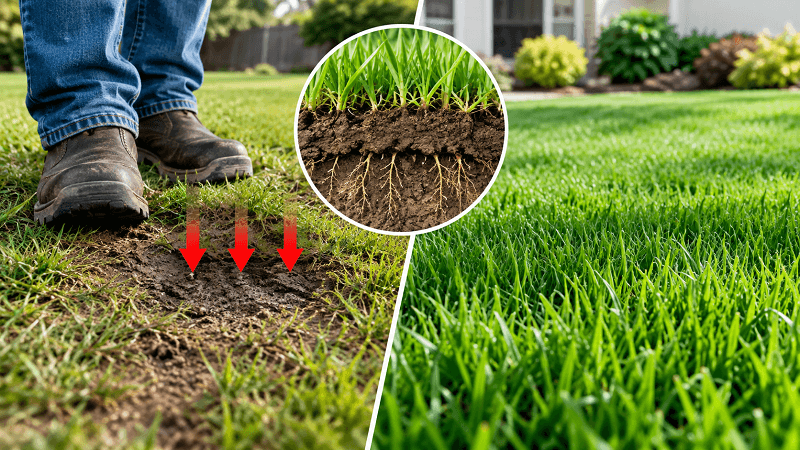
Every patch of grass relies on a deep, stubborn root system to survive. When soil particles get squeezed together into the density of concrete, those delicate roots won’t be able to punch through.
Instead of growing deep into the earth, roots are forced to stay shallow and thin. That leaves your lawn completely defenceless against the mildest dry spells, sudden frosts, and any foot traffic.
When soil gets this hard, stepping on your lawn can pull grass blades loose. It’s why so many lawns go brown the second a heatwave hits—no matter how religiously you stand outside with a hose at 8:00 PM.
Poor Water Absorption
Compacted soil reacts to rain the exact same way a closed umbrella does: water runs right off it.
Rather than soaking down to where the roots actually are, rainwater pools into mini lakes on the surface or runs straight into the patio drain.
This creates a bizarre contradiction. The top of your lawn ends up looking like a swampy marshland after a heavy thunderstorm, yet the soil just three inches down remains as dry as a desert bone.
In heavy rain, it’s frustrating to watch all that water go to waste. Instead of soaking down to feed the roots, it just washes off into the drain, leaving your grass parched even after a storm.
And with summer hosepipe bans becoming an annual ritual, watching precious rainwater slide off your rock-hard lawn is a special kind of garden heartbreak.
Reduced Airflow in the Soil
Grass roots need oxygen just as much as they need water, but severe compaction squeezes every last air pocket out of the dirt.
Healthy soil is full of micro-gaps that allow air to circulate freely around the root zone. Compaction crushes these gaps flat, leaving the roots to slowly suffocate.
Without steady oxygen flow, the plant cannot convert stored sugars into energy, effectively stalling top growth and turning the grass a dull, sickly yellow.
Over time, this lack of air causes stagnant water and organic matter to rot underground. This creates an unhealthy soil environment that reduces beneficial earthworm and microbial activity, making it even harder for your lawn to recover.
Limited Nutrient Uptake
Even if you buy the most expensive, professional-grade lawn food on the market, compressed soil will block it, which will prevent it from working effectively.
Most granular fertilisers need soil moisture and open pore spaces to move into the root zone, where the grass can absorb them effectively.
When you apply fertiliser to compacted ground, it can’t reach the roots where it is needed most. Here’s what happens when feed hits rock-hard soil:
- Nutrient Runoff. Rain and hose water can’t penetrate the dense ground, so granules melt on the surface and wash away into flowerbeds or patio drains before reaching the roots.
- Surface Burning. Fertiliser granules that get stuck on top of the hard soil sit directly against the base of the grass blades. Instead of soaking into the dirt, these concentrated chemical salts draw moisture right out of the plant, scorching the leaves.
- Locked-Out Nitrogen. Beneficial soil microbes need oxygen to convert nitrogen into a usable form for plants; without air, that expensive feed stays chemically locked away in the dirt.
- Wasted Money. You may end up buying more product to fix pale, weak grass, but until the soil is opened up, much of it never reaches the root zone.
Slower New Grass Growth
If you’ve ever overseeded a bare patch and watched precisely nothing happen, compaction is probably the culprit. New grass seed needs loose, workable soil to send roots down and establish itself.
Hard, compressed ground makes that process painfully slow, if it happens at all. The same goes for fresh turf, which often struggles to root down into compacted soil underneath it.
Repair the same patch a few times without addressing compaction, and you’ll end up with a lawn that looks more like a patchwork quilt than a garden.
Restoring a Compacted Lawn
The good news is that compacted soil is easy to fix. A few consistent habits, ideally timed for spring or autumn, can turn things around. Here’s where to start.
- Aerate regularly. Spiking or hollow-tine aerating the lawn creates channels for air, water, and nutrients to reach the roots again. Autumn and spring tend to be the best windows for this, when the ground isn’t bone dry.
- Top-dress with compost. Working a thin layer of compost into freshly aerated holes gradually improves the structure of the soil. It’s a simple step, but one that keeps paying off season after season.
- Rethink high-traffic areas. Laying stepping stones or a simple path across busy routes can spare the grass from constant compression. It won’t solve compaction on its own, but it does take the pressure off the worst-affected patches.
- Call in the professionals. It’s worth turning to professional lawn care for gardens, as experts can assess deep compaction properly and treat the problem right at the root.
Combine a few of these habits, and your compacted lawn will bounce back within a season or two.
Conclusion
So there you have it: your lawn just needs a bit of breathing room. A spot of aeration, a little patience, and walking on the garden path instead of straight across the grass will have that lush green carpet back in good shape before you know it.